
Migrating from Kubernetes Ingress to Gateway API: A Zero-Downtime Production Success Story
Kubernetes networking has reached a critical inflection point. For years, the Ingress API together with controllers like NGINX Ingress powered most production workloads. That chapter is now closing. As of March 2026, the widely used NGINX Ingress Controller has reached End-of-Life, with no further security updates. Organizations still running it face growing security and compliance…

Exploring Kine: The Etcd Shim Revolutionizing Kubernetes Storage
In the world of container orchestration, Kubernetes is the de facto standard. However, its core component—the etcd key-value store—can be a heavyweight dependency for edge environments or small clusters. Enter K3s, Rancher’s minimalist distribution, and its secret weapon: Kine. What is Kine? Kine (pronounced “kine” like “bovine”) is an open-source etcd shim. It acts as…

Capturing Network Traffic Over Cilium VTEP Tunnels with eBPF: A Practical Guide
In modern Kubernetes environments, connecting external systems—like virtual machines, legacy appliances, or third-party load balancers—to pods often requires overlay tunneling. Cilium’s VTEP (VXLAN Tunnel Endpoint) integration makes this seamless by allowing direct VXLAN communication between Cilium-managed pods and external VTEP devices. But how do you actually observe and debug the traffic flowing through these tunnels…
Centralizing Helm: Why Ingress Failed and HTTPProxy Won
As organizations grow, so does the complexity of managing Kubernetes manifests. A natural evolution is moving to centralized “umbrella” Helm charts. The promise is alluring: consistency across services, reduced duplication, and a streamlined CI/CD pipeline where global policies (like security and resource limits) are enforced in one place. However, this refactor often exposes hidden architectural…
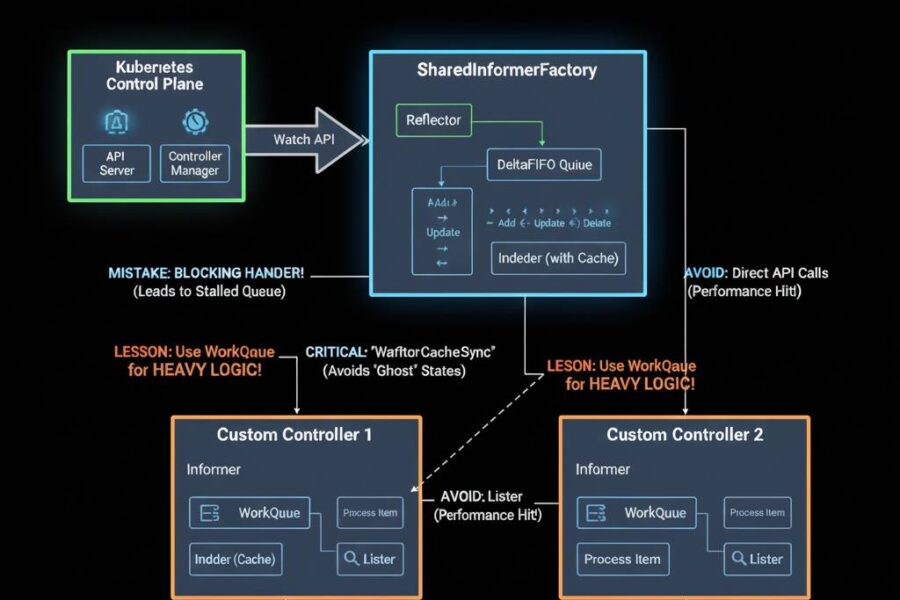
Mastering Kubernetes Informers: Lessons from the Trenches to Avoid Costly Mistakes
In the world of Kubernetes, where orchestration reigns supreme, keeping track of cluster resources efficiently is crucial for building reliable systems. At Render, engineers encountered real-world challenges while using Kubernetes Informers to monitor Pod scheduling in massive clusters. Informers, those handy tools for streaming resource updates, are incredibly powerful—but as it turns out, they’re also…
Avoid Breaking Your Cluster: How Kube No Trouble (kubent) Helps Detect Deprecated Kubernetes APIs
As Kubernetes continues its rapid evolution—with new minor releases every few months—cluster administrators face a recurring challenge: upgrading safely without disrupting workloads. One of the biggest risks during an upgrade is deprecated or removed APIs. If your deployments, DaemonSets, Ingresses, or other resources still reference API versions that have been phased out, the upgrade can…
KubeDiagrams: Automatically Generate Stunning Kubernetes Architecture Diagrams from Code and Clusters
In the fast-paced world of Kubernetes, keeping architectural documentation in sync with your actual deployments is a constant challenge. YAML manifests pile up, Helm charts evolve, and live clusters drift—leaving diagrams outdated or, worse, non-existent. Enter KubeDiagrams, an open-source tool that automates the creation of clear, professional architecture diagrams directly from your Kubernetes resources. Whether…

Breaking Boundaries: Why Kubernetes Namespaces Aren’t Security Boundaries
Multi-tenancy in Kubernetes is a paradox. Organizations want the cost-efficiency of a single cluster shared by multiple teams, but Kubernetes was never designed to be a “hard” multi-tenant system. As a security researcher, I’ve found that “Tenant Admins”—users restricted to a single namespace—can often escalate to Cluster Admin using the very tools meant to keep…
AKS Automatic vs. AWS EKS Auto Mode and GKE Autopilot: Simplified Kubernetes Showdown
Microsoft Azure Kubernetes Service (AKS) Automatic: Revolutionizing Kubernetes Management with Intelligent Automation Kubernetes has undeniably become the industry standard for container orchestration, powering applications at scale across countless organizations. However, managing Kubernetes clusters in production has often been considered a challenging task, requiring specialized DevOps expertise and significant operational effort. Recognizing this complexity, Microsoft has…

Boosting Scheduler Speed: Asynchronous API Calls Transform Pod Placement
Kubernetes 1.34: Exploring the Exciting Alpha Features As Kubernetes gears up for its 1.34 release on August 27th, 2025, it brings a treasure trove of powerful capabilities especially aimed at improving device management, pod lifecycle controls, and cluster scheduling performance. Designed to empower cluster administrators, application developers, and DevOps teams alike, these alpha features promise…